


 Zoom Link to Join the Seminar

Our Zoom plan has a limit of 300 participants. So to make sure you get a spot, it might be a good idea to join a bit early. See you there!
#5 Sungjin Ahn (KAIST)
Title: World Theory Models: A Third Generation of World Models
Abstract: What does it mean for a machine to understand the world? Today’s world models largely equate understanding with accurate future prediction. The first generation, exemplified by Dreamer, learns by reconstructing observations. The second, exemplified by JEPA, drops reconstruction and predicts in a learned latent space. Yet both struggle with novel compositions, distribution shift, and what-if reasoning, because they learn a map of the world rather than the mechanisms behind it. Developmental cognitive science suggests a different view: long before acquiring language, children construct theories that explain how and why the world changes. In this talk, I will discuss recent work on World Theory Models (WTMs), which I see as a third generation of world models. WTMs infer explicit, executable, and compositional theories of the world from raw observation alone. I will illustrate how such theories can be recombined to explain novel phenomena, and close with open challenges in scaling them and connecting them with symbolic world models.Bio: Sungjin Ahn is an Associate Professor in the Department of AI Computing and the School of Computing at KAIST, where he directs the Machine Learning and Mind Lab and the KAIST-Mila Prefrontal AI Research Center. He is also a joint appointment professor at New York University. He received his Ph.D. from the University of California, Irvine under Max Welling, completed his postdoctoral training at Mila with Yoshua Bengio, and was an Assistant Professor of Computer Science at Rutgers University before joining KAIST. His research focuses on world models and building AI that understands the world the way humans do.
Date & Time: October 30 (Friday) at 2:00 PM (KST)Location: Join us on this Link.Contact: Prof. Sungjin Ahn (sungjin.ahn@kaist.ac.kr)
#4 Taylor Webb (Université de Montréal & Mila)
Title: Emergent symbol processing in transformer language models
Abstract: Human cognition is characterized by a remarkable ability to recombine familiar elements in novel ways. This capacity for compositionality has been at the heart of the longstanding debate between neural networks and symbolic models of cognition, with some arguing that innate symbolic algorithms are needed to explain this capability. In this talk, I will discuss recent work investigating the learned mechanisms that support cognitive processing in large language models and vision language models, and illustrate how these mechanisms implement an emergent form of symbol processing, suggesting a surprising resolution to this longstanding debate.
Bio: Taylor Webb is an assistant professor in the department of psychology at the Université de Montréal, and an associate faculty member at the Mila Québec AI institute. His work investigates the computational basis of abstract reasoning in both artificial intelligence and the human brain.
Date & Time: March 27 (Friday) at 9:00 AM (KST)
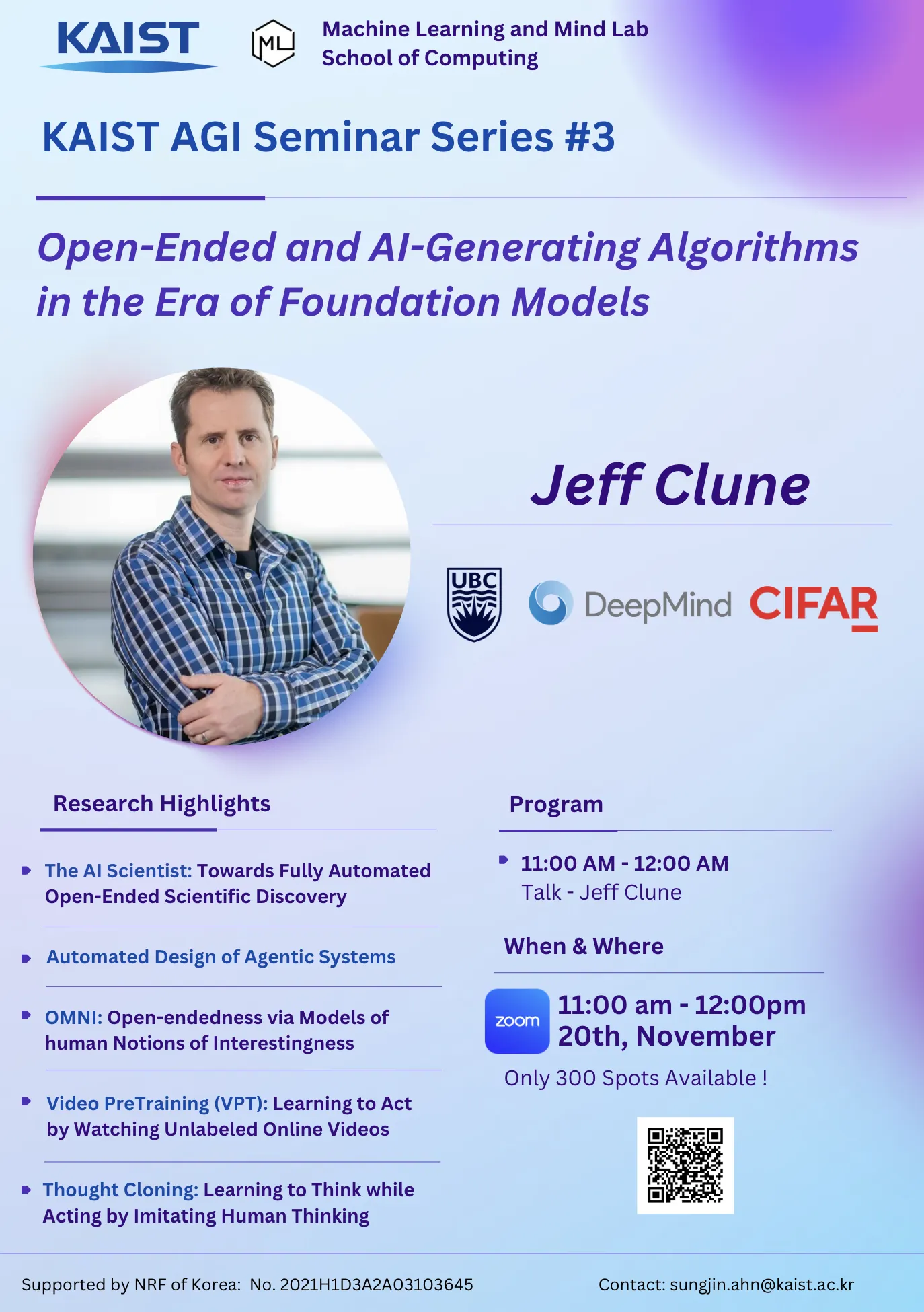
#3 Jeff Clune (University of British Columbia & Google DeepMind)
Title: Open-Ended and AI-Generating Algorithms in the Era of Foundation Models
Abstract. Foundation models (e.g. large language models) create exciting new opportunities in our longstanding quests to produce open-ended and AI-generating algorithms, wherein agents can truly keep innovating and learning forever. In this talk I will share some of our recent work harnessing the power of foundation models to make progress in these areas. I will cover our recent work on OMNI (Open-endedness via Models of human Notions of Interestingness), Video Pre-Training (VPT), Thought Cloning, Automatically Designing Agentic Systems, and The AI Scientist.
When: @11/20/2024 11:00am
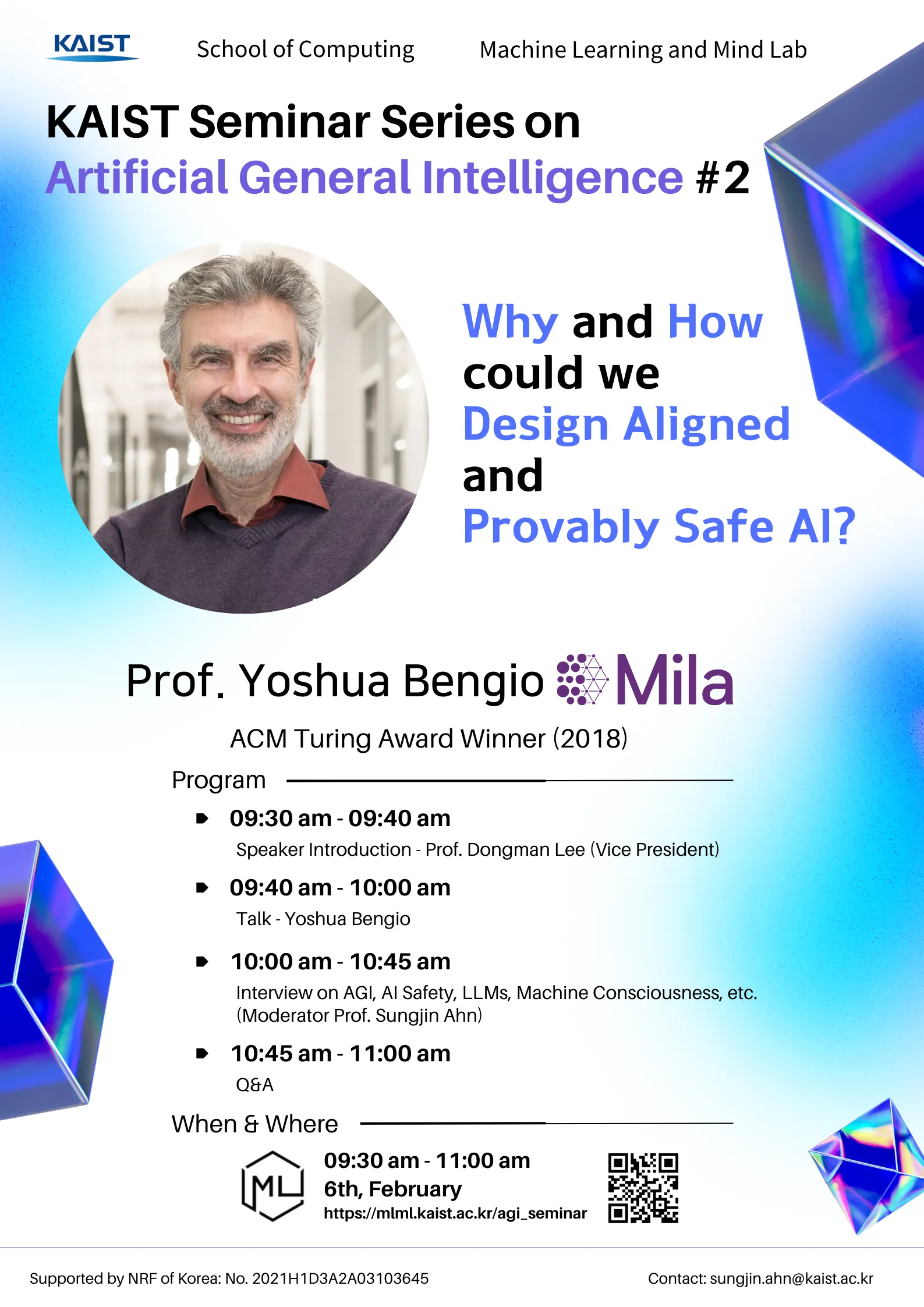
#2 Yoshua Bengio (Mila & University of Montreal)
Title: Why and how could we design aligned and provably safe AI?
Abstract. This presentation will start by providing context for avoiding catastrophic outcomes from future advanced AI systems, in particular on the need to address both the technical alignment challenge and the political challenge of coordination and democratic governance, at national and international levels. I will then outline a machine learning research program to obtain quantitative and conservative risk evaluations to address the alignment challenge. This is based on amortized inference of Bayesian posterior over causal theories of the data available to the AI, using generative AI to approximate that posterior and mathematical methods developed recently around generative flow networks (GFlowNets).
When: @2/6/2024, 9:30:00 AM
Where: Zoom
Video link: https://www.youtube.com/watch?v=Sc5a_LmvlXI
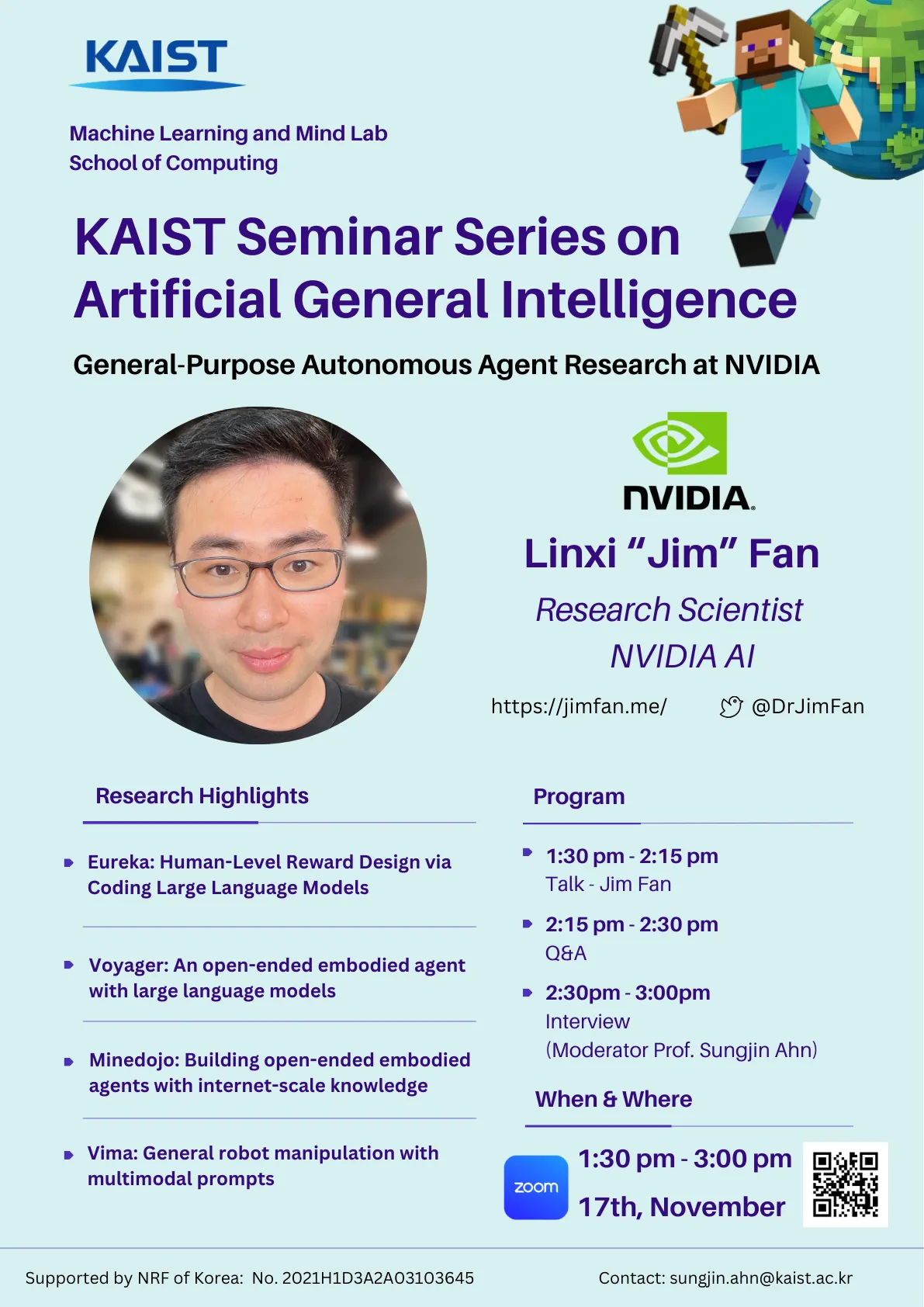
#1 Jim Fan (NVIDIA)
Title: Generalist Agents in Open-Ended Worlds
When: @11/17/2023, 1:30:00 PM
Where: Zoom